From India to Venice
Venue: Palazzo Barbaro, Fondamenta Barbaro, 2840, 30124 Venezia VE, Italy
Venice Biennale Press Preview: Tuesday 5th May, 09.00 AM - 11.30 PM
Exhibition Dates: Wednesday, 6th May - Monday, 6th July
Operating Days: Monday, Wednesday, Friday, Saturday, Sunday
Hours: 11:00 AM – 5:00 PM
Strictly by appointment only.
contact@royer.paris
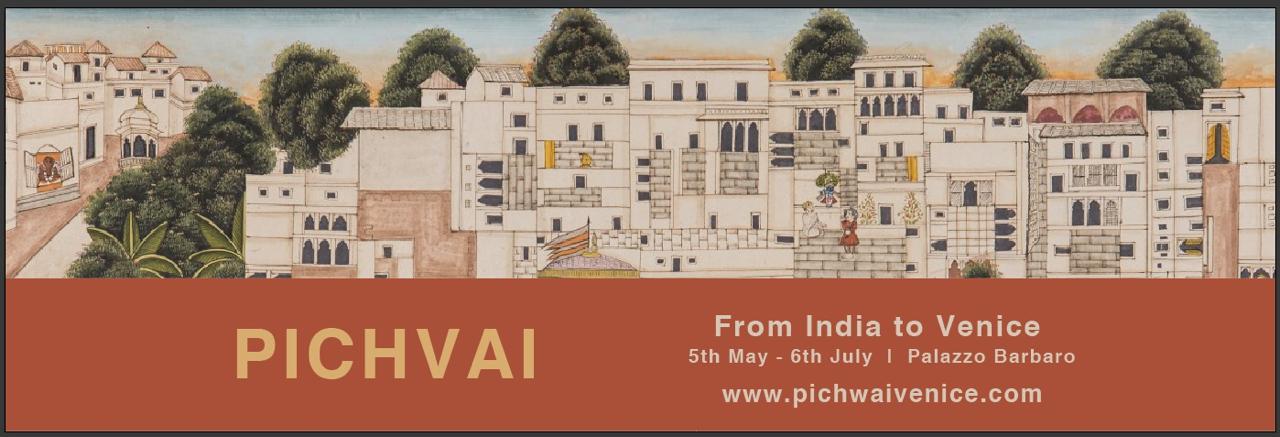
Venice, Italy | May 2026: Pooja Singhal, Founder of Pichvai Tradition & Beyond, presents From India to Venice, a satellite event during the coinciding with La Biennale di Venezia, opening Wednesday, 6th May at the Palazzo Barbaro. The exhibition brings the four-century-old Pichwai tradition of Nathdwara, Rajasthan into dialogue with the architectural and cultural landscape of Venice.
Conceptualised and developed in collaboration with art historian and curator Elizabeth Royer, who lives between Paris and Venice, and Michele Coldoni, the presentation positions a deeply devotional Indian art form within an international contemporary context.
Traditionally created as hand-painted textiles hung behind the idol of Shrinathji, a cherubic incarnation of Lord Krishna, Pichwais depict temple rituals, seasonal cycles, and sacred geographies through detailed compositions. Over the past decade, Pooja Singhal has worked with artists in Nathdwara to restore the rigour of the practice while extending its vocabulary through new formats, materials, and scales. The atelier today operates through a model where senior artists train younger practitioners within a lineage-based system, ensuring continuity while adapting the practice to contemporary contexts.
From India, to Venice builds from key visual forms within the Pichwai tradition, particularly the temple map. At the centre of the exhibition, comprising of ten large scale works, is a series of reinterpretations of this intricate 400- year- old genre; once used to depict the haveli of Shrinathji and the town of Nathdwara, artworks are reimagined here through the city of Venice. This approach uses the established language of the tradition to render a new geography.
The exhibition also includes works rendered in khakha, the preparatory drawing method traditionally used by artisans to map large-scale Pichwai compositions. These finely structured line drawings and sketches offer insight into the architectural thinking that underpins the tradition. A large textile sketch work also draws from imagery within the miniature tradition, where the movement of figures finds a parallel in the visual language of Venetian Carnival.
This exhibitionintegration of art, food, and environment builds on Singhal’s earlier presentations across India and internationally, where Pichwai has been explored beyond the canvas through immersive formats. WithAt From India to Venice, this approach finds new resonance within the context of Venice, offering a layered encounter with a living tradition as it moves across geographies.